
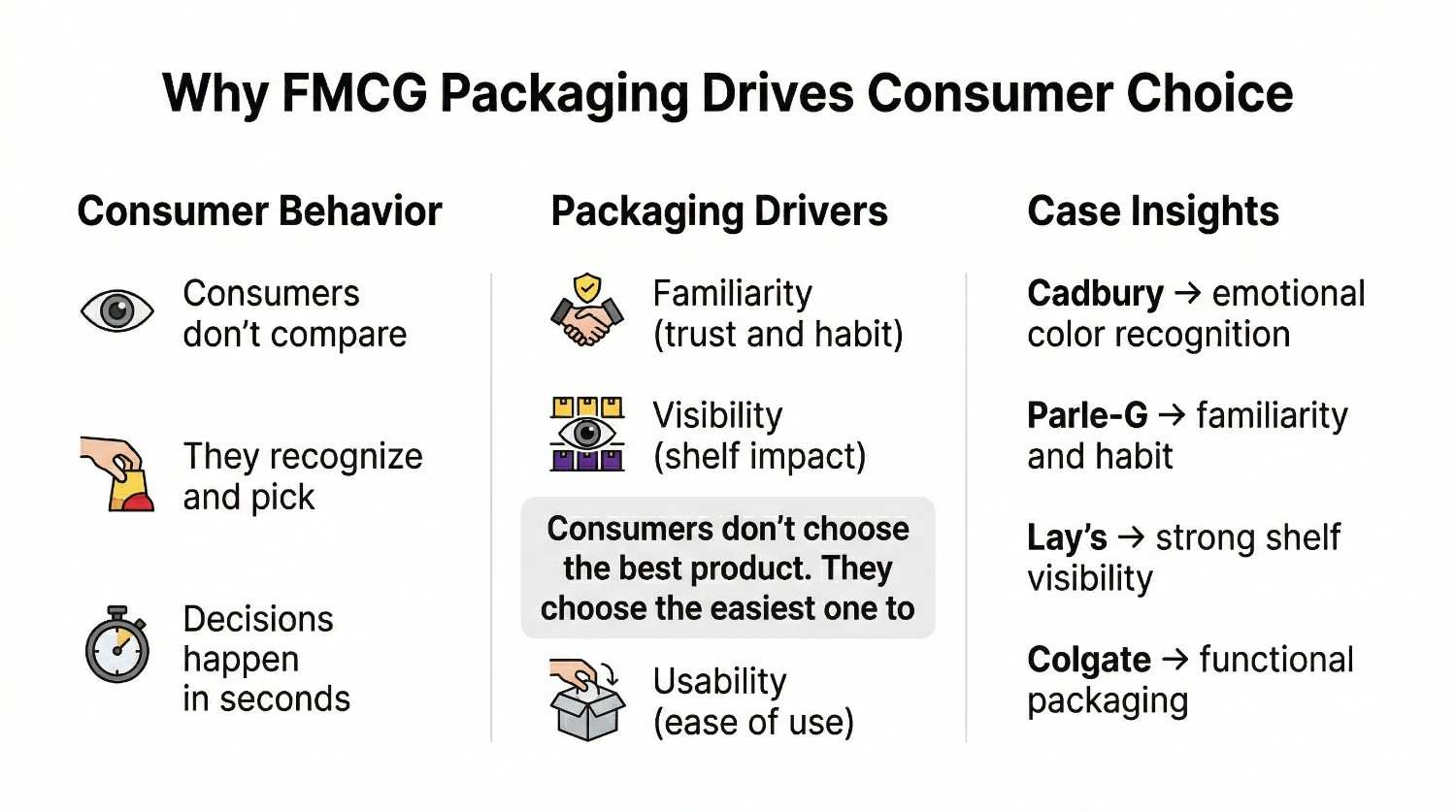
Why You Pick One Product Without Thinking
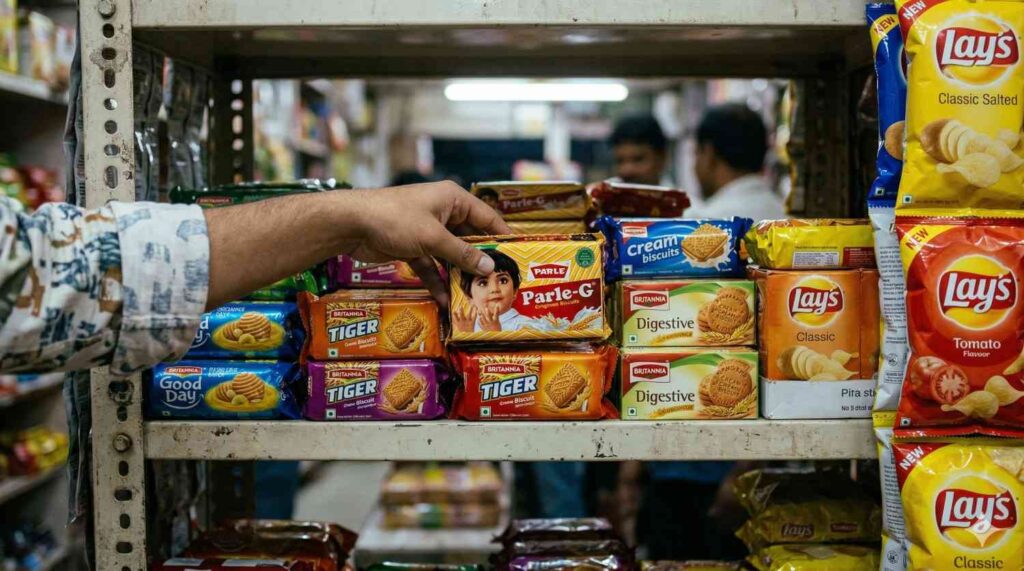
You walk into a store to buy biscuits there are 10 options, you don’t compare ingredients, you don’t calculate value, you just pick one.
And most of the time—
You pick the one that feels familiar that decision isn’t random it’s driven by FMCG packaging.
The Real Role of Packaging
In FMCG, people don’t “decide.” They:
- Scan
- Recognize
- Pick
All within seconds.
Which means the product that gets picked is not always the best one. It’s the one that is easiest to choose. This is where packaging and branding come together. Packaging becomes:
- A shortcut for trust
- A signal of quality
- A trigger for action
Real-World Case Studies
Cadbury — Packaging as Emotion
Cadbury’s packaging is one of the strongest examples of brand identity packaging.
The iconic purple color:
- Instantly signals indulgence
- Feels premium
- Stands out without effort
You don’t read “Cadbury.” You recognise the purple.
What’s happening:
- Color builds memory
- Consistency builds trust
- Emotion drives choice
Insight – Cadbury proves that product packaging strategy can create emotional recall—so strong that the product gets picked automatically.
Parle-G — Packaging as Habit
Parle-G hasn’t changed much and that’s exactly why it works, the packaging:
- Looks the same
- Feels familiar
- Signals trust
For many consumers, it’s not a decision. It’s a default.
What’s happening:
- Familiar packaging reduces thinking
- Consistency reinforces habit
- Habit drives repeat purchase
Insight- Parle-G shows that in consumer packaging, stability can outperform innovation.
Lay’s — Packaging as Visibility
Lay’s wins at the shelf, not by being subtle—but by being impossible to ignore.
Its packaging:
- Uses bold, bright colors
- Differentiates flavors clearly
- Dominates visual space
You don’t search for Lay’s, you spot it instantly, what’s happening:
- Color grabs attention
- Clarity speeds up decisions
- Visibility drives impulse
Insight- Lay’s shows how FMCG packaging design can directly drive impulse buying.
What This Really Means
Across all these brands, one thing is clear that consumers don’t pick the best product, they pick the one that is:
- Easiest to recognize
- Easiest to trust
- Easiest to use
This is the real role of packaging.
What Marketers Can Learn
- Packaging is not design—it’s strategy
- It reduces decision friction
- It builds recognition over time
- It directly impacts conversion
Most importantly packaging doesn’t just protect the product, it gets the product chosen.
Conclusion
In FMCG, decisions are fast, habitual, and visual consumers don’t analyse—they recognise from Cadbury’s emotional cues to Parle-G’s familiarity, Lay’s visibility, and Colgate’s functionality, each example shows a different dimension of effective FMCG packaging.
Together, they reveal a simple truth that the brands that win are not just better, they are easier to choose.
FAQ
FMCG packaging refers to how products are designed and presented to attract consumers and enable easy usage.
Because it influences visibility, recognition, and usability—key factors in fast consumer decisions.
It reduces effort, builds trust, and triggers recognition, leading to quicker purchases.
Packaging reinforces identity and creates both emotional and functional connections with consumers.
Must read: Why Ads Don’t Sell—Distribution Does