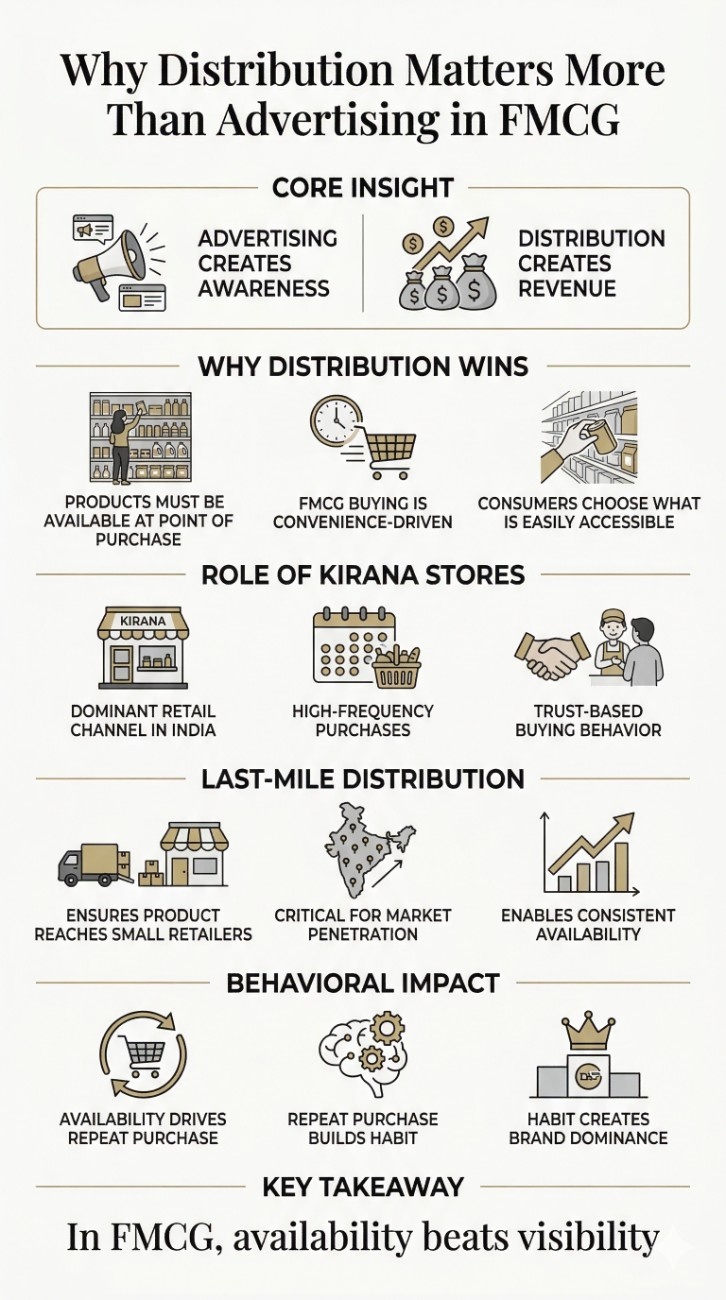
Why Some FMCG Brands Are Seen Everywhere—but Bought Nowhere
Most people believe FMCG brands grow because of advertising.
Big campaigns. Celebrity endorsements. High recall.
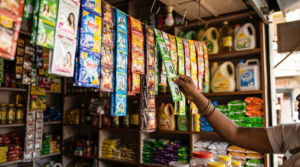
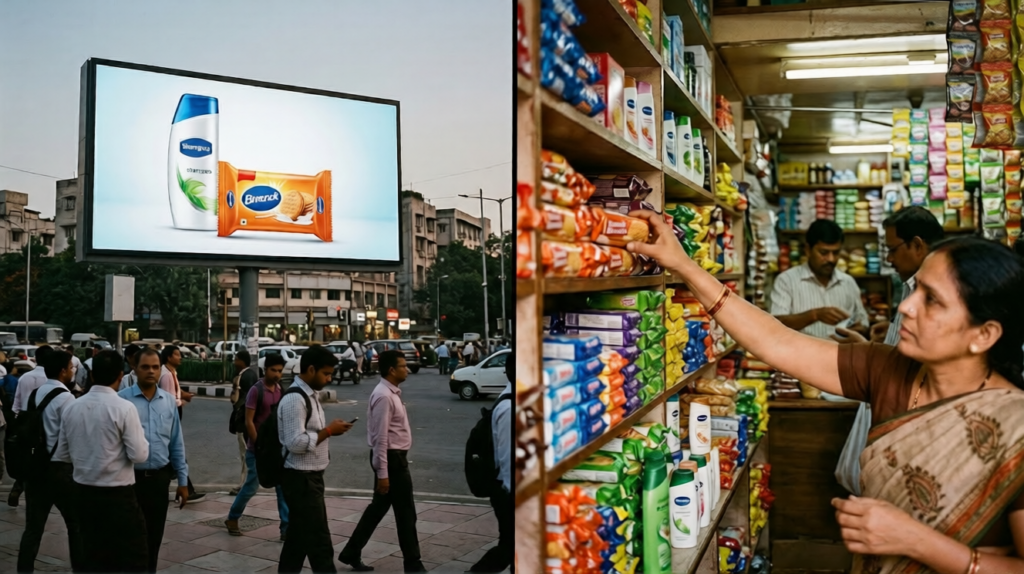
But walk into any kirana store, and a different reality emerges.
The brands that win are not always the ones you remember.
They’re the ones you can find easily.
This is where FMCG distribution strategy in India becomes the real driver of success.
The Reality of FMCG Consumption
FMCG is not a “search-driven” category.
Consumers don’t:
- Compare extensively
- Research deeply
- Delay purchases
They buy:
- What is available
- What is familiar
- What is convenient
This is why the FMCG distribution strategy plays a more critical role than advertising.
Availability > Awareness
Advertising plays a role—it creates awareness.
But awareness alone does not drive sales.
If a consumer walks into a store and your product is not available, the decision is immediate:
They choose an alternative.
This is why the FMCG distribution strategy in India is critical.
- Advertising creates demand.
- Distribution converts demand into revenue.
The Kirana Store Advantage
In India, kirana stores dominate retail.
They are:
- Hyper-local
- High-frequency
- Trust-driven
A strong FMCG distribution strategy ensures:
- Deep penetration into kirana networks
- Consistent stock availability
- High visibility at the point of purchase
This is where brands win—not on billboards, but on shelves.
Last-Mile Distribution
Distribution in FMCG is not just about reaching cities.
It’s about reaching every possible point of sale.
This includes:
- Small towns
- Rural markets
- Local retail stores
The challenge lies in last-mile delivery—ensuring products reach even the smallest outlets.
Brands that excel in FMCG distribution strategy in India:
- Scale faster
- Build a stronger presence
- Become the default consumer choice
Real-World Case Study: Distribution vs Advertising in FMCG
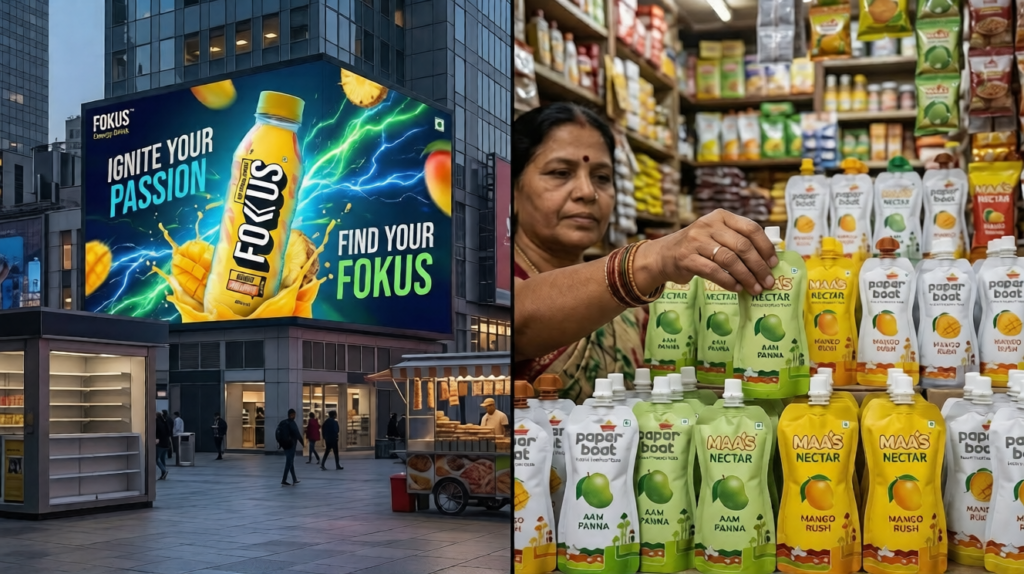
Case 1: When Advertising Fails Without Distribution
Fokus Energy Drink
Fokus Energy Drink entered the market with strong visibility and digital presence.
The brand invested in:
- Influencer marketing
- Youth-focused campaigns
- Online brand building
On the surface, the strategy seemed effective.
But the real issue wasn’t awareness.
It was availability.
Consumers who discovered the product:
- Couldn’t find it in nearby stores
- Didn’t see it in Kirana outlets
- Rarely encountered it at purchase points
This created a critical gap:
Interest existed, but it couldn’t convert into sales.
Case 2: When Distribution Wins With Strategic Differentiation
Paper Boat
Paper Boat entered the FMCG beverage market as a new-age brand.
Instead of relying heavily on aggressive advertising, it focused on:
- Strong distribution networks
- Presence across retail formats
- Consistent availability
Consumers didn’t need to search for the product.
They encountered it naturally during purchase.
Packaging as a Strategic Advantage
Beyond distribution, Paper Boat leveraged distinctive packaging to stand out.
Unlike traditional bottles and cans, it used:
- Soft, flexible pouches
- Rounded, compact designs
- Easy-to-carry formats
What Marketers Can Learn
These examples highlight key principles:
- Marketing doesn’t end at awareness
- Distribution is part of the marketing strategy
- Availability drives conversion
- Packaging enhances visibility and recall
Conclusion
In FMCG, advertising may create awareness, but it is distribution that ultimately drives sales. Consumers in this category rarely engage in deep evaluation—they choose what is easily available, familiar, and convenient at the point of purchase. This makes the FMCG distribution strategy in India a critical competitive advantage rather than just an operational function. As seen in the contrast between Fokus Energy Drink and Paper Boat, even strong marketing efforts fail without availability, while consistent distribution—supported by thoughtful packaging and positioning—can build long-term brand success. Ultimately, the brands that win are not just the most visible, but the most accessible in everyday consumer decisions.
Frequently Asked Questions (FAQ)
FMCG distribution strategy in India refers to how products are delivered and made available across retail channels to ensure accessibility for consumers.
Because FMCG purchases are convenience-driven. If a product is not available at the point of purchase, advertising cannot convert into sales.
It refers to delivering products to the final retail point, such as small kirana stores, ensuring widespread availability.
Packaging improves visibility, convenience, and emotional connection, making products more attractive and easier to choose at the shelf level.