Introduction
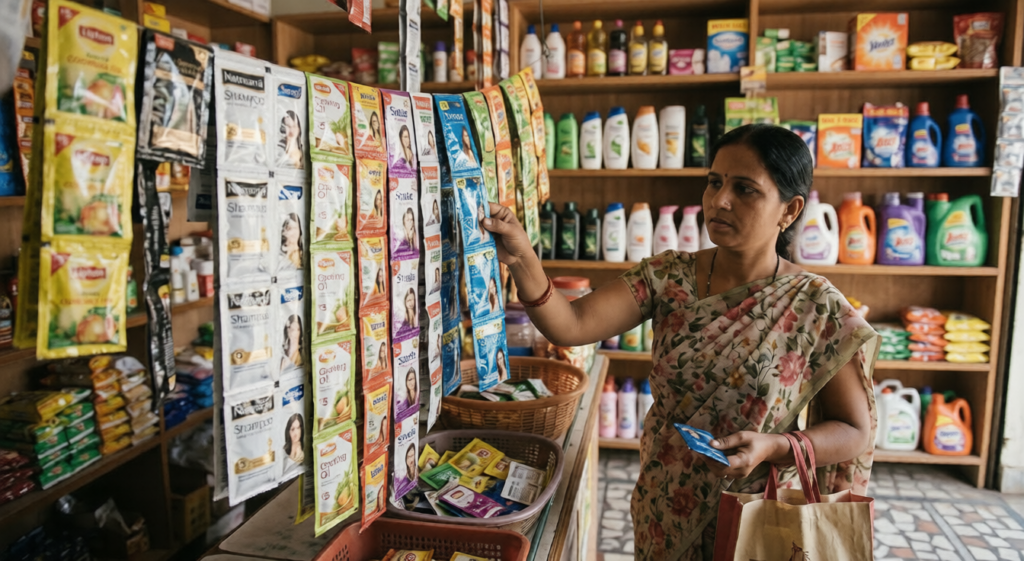
Walk into any kirana store in India, and one thing stands out—rows of tiny sachets priced at ₹1, ₹2, or ₹5.
From shampoo to detergent, these small packs are everywhere.
At first glance, it seems counterintuitive. Why would consumers buy smaller quantities at a higher per-unit cost?
The answer lies in sachet marketing in India, a strategy deeply rooted in consumer behaviour and market realities.
Sachet marketing in India is not just a pricing tactic—it is a behavioural strategy that aligns with how millions of consumers make daily purchasing decisions.
Understanding the Indian Consumer
To understand the success of sachet marketing in India, we need to understand the consumer.
A large segment of Indian consumers:
Earn daily or weekly income
Prefer smaller, frequent purchases
Avoid high upfront spending
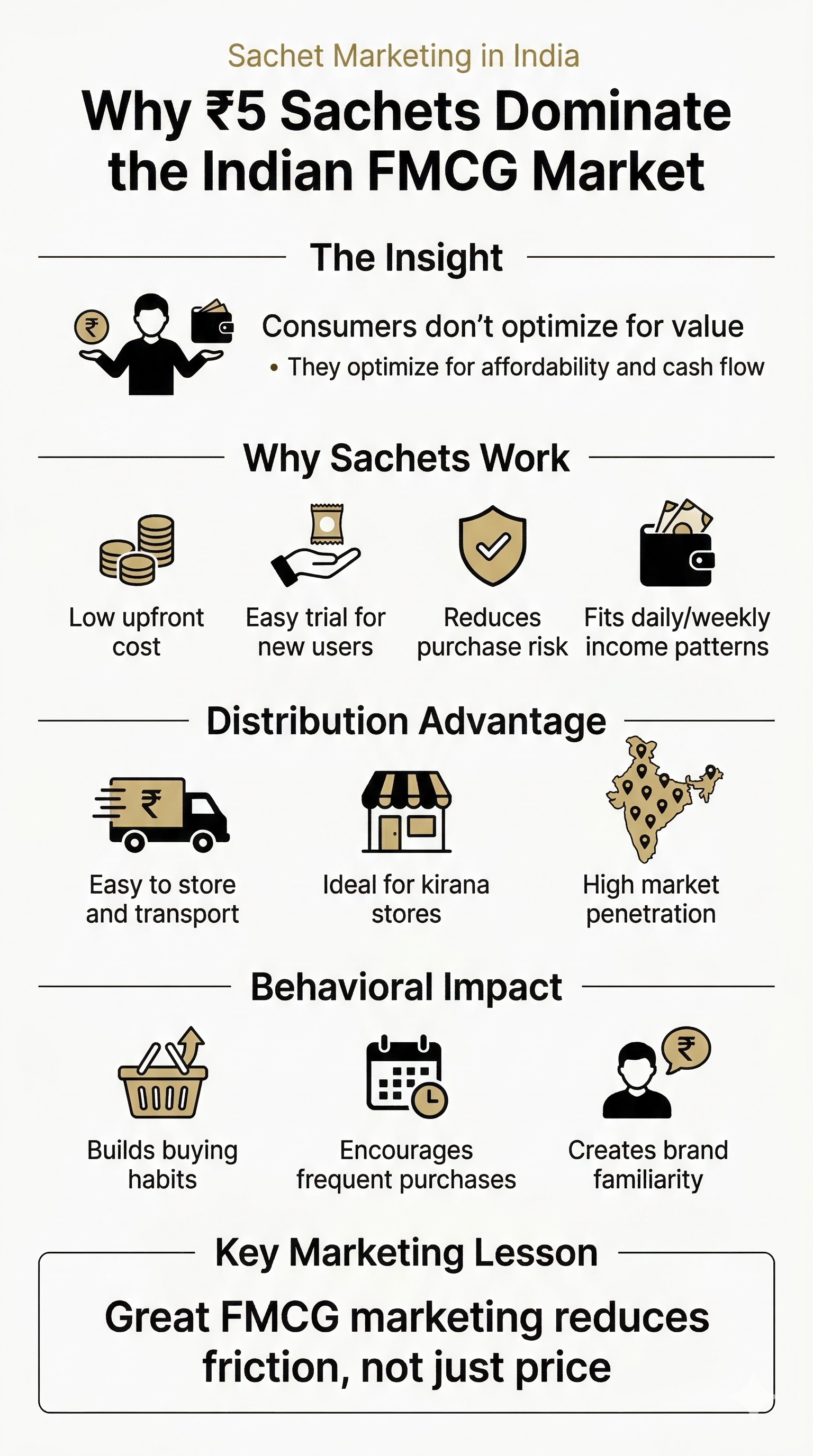
This creates a market where affordability is not about total price—but about immediate affordability.
Sachet marketing in India works because it aligns perfectly with this cash-flow-driven mindset.
Affordability vs Value
From a purely economic perspective, sachets are more expensive per unit.
But consumers don’t think in terms of per-unit cost.
They think in terms of:
“What can I afford right now?”
“What is the lowest risk purchase?”
Sachet marketing in India reduces the psychological barrier to purchase.
Instead of committing ₹200, a consumer can try a product for ₹5.
Trial and Brand Entry
Another reason sachet marketing in India is so effective is that it enables trial.
For new consumers:
Low-cost entry reduces hesitation
Encourages experimentation
Builds familiarity with the brand
Many FMCG brands use sachets as a customer acquisition strategy, especially in rural and semi-urban markets.
Distribution Advantage
Sachet marketing in India is also closely tied to distribution.
Small packs:
Are easier to transport
Require less shelf space
Fit perfectly into kirana store ecosystems
This allows brands to penetrate deeper into markets where large packs might not be practical.
Habit Formation
Over time, sachet marketing in India doesn’t just drive sales—it builds habits.
Consumers begin to:
Buy frequently
Stick to familiar brands
Repeat purchases without much thought
This is where FMCG brands win—not just through pricing, but through behavioural consistency.
What Marketers Can Learn
Sachet marketing in India teaches a powerful lesson:
Consumers don’t optimise for value—they optimise for convenience and affordability
Pricing is not just economic—it is psychological
Distribution and accessibility often matter more than advertising
Conclusion
Sachet marketing in India is one of the most powerful examples of how deeply understanding consumer behavior can shape an entire industry.
It is not just about selling smaller quantities.
It is about reducing friction, enabling access, and aligning with how people actually live and spend.
In FMCG, the brands that win are not the ones that shout the loudest—but the ones that fit seamlessly into everyday life.
Frequently Asked Questions (FAQ)
Sachet marketing in India refers to the strategy of selling products in small, low-cost packaging (₹1–₹5 packs) to make them affordable and accessible to a larger population. It is widely used in FMCG categories like shampoo, detergent, and personal care.
Sachets are popular because they align with consumer purchasing behavior. Many consumers prefer low upfront spending, making small packs easier to buy frequently. This makes sachet marketing in India highly effective.
Yes, sachets are often more expensive per unit compared to larger packs. However, consumers prioritize affordability and convenience over per-unit cost, which is why sachet marketing in India continues to succeed.
Sachet marketing helps brands by:
Enabling product trials
Increasing market penetration
Reaching rural and low-income consumers
Building long-term consumption habits